
Most localization teams already rely on Translation Management Systems.
Tools like Crowdin are well established for handling product interfaces, documentation, and structured content at scale.
But motion design has largely remained outside of that ecosystem.
Not because it’s less important — but because the tooling hasn’t existed.
Motion graphics have been the gap
Video is now central to product communication:
- onboarding flows
- marketing campaigns
- social content
- in-app animations
Yet when it comes to localization, motion graphics are still handled manually.
Designers working in Adobe After Effects export text, send files around, rebuild compositions, and try to preserve timing and layout across languages.
Meanwhile, localization teams continue to operate inside their TMS — without visibility into how that content actually appears on screen.
The result is a disconnect:
- between tools
- between teams
- and often, between intent and final output
Introducing a missing category: TMS for motion
Cult Connector introduces a new type of integration:
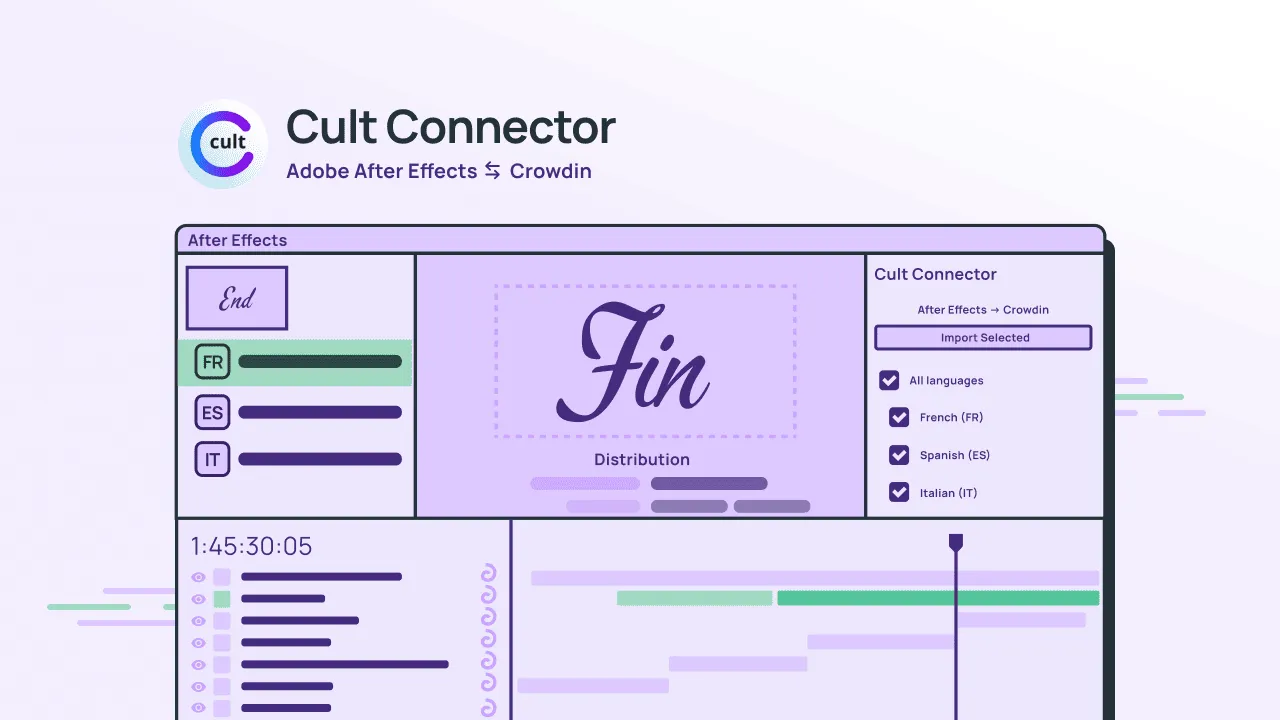
A direct connection between After Effects and a TMS.
With Crowdin as the first integration, motion graphics can now enter the same pipeline as the rest of your localized content.
- Text layers are extracted directly from compositions
- Screenshots are attached automatically for context
- Content is structured and sent to Crowdin projects
- Translations return as ready-to-review compositions
No intermediate formats.
No manual reconstruction.
Why this matters
This is less about speed — and more about alignment.
Localization teams already have:
- workflows
- QA processes
- terminology control
- collaboration layers
But motion design hasn’t been part of that system.
By connecting After Effects directly to a TMS:
- designers don’t need to adapt their workflow
- localization teams don’t lose visibility
- both sides work on the same structured content
Context becomes part of the system
One of the main limitations of traditional localization workflows is context.
Strings are often translated in isolation.
In motion design, that’s a problem.
Timing, layout, and animation all influence meaning.
By attaching screenshots to each text layer:
- translators see exactly how content appears
- reviewers can validate intent more accurately
- fewer iterations are needed to fix misinterpretations
For more complex compositions, frame-accurate markers allow designers to define exactly which moment should represent each string.
From rebuilding to continuity
A key shift in this workflow is what happens after translation.
Instead of rebuilding compositions:
- translated versions are generated automatically
- typically one per language
- preserving structure, timing, and layout
This reduces friction, but more importantly, it reduces risk.
The original composition remains the source of truth.
A first step, not a closed system
Crowdin is the first integration.
That matters.
It signals that motion graphics are starting to integrate into established localization infrastructures — not as an exception, but as part of the pipeline.
And it opens the door to a broader ecosystem where:
- motion design is treated as structured, localizable content
- TMS platforms extend beyond text-based products
- creative and localization workflows are no longer isolated
Where this leads
As video continues to scale across products and markets, the current approach doesn’t hold.
Manual workflows don’t scale with content volume.
Disconnected tools don’t scale with team complexity.
What’s needed is not just better export/import.
It’s integration.
Cult Connector is one step in that direction:
bringing motion graphics into the TMS workflow, starting with Crowdin.